
The ZFC system (Zermelo–Fraenkel + Axiom of Choice) is the standard foundation of modern mathematics. This article concisely presents the axioms so they can be cited later, including in actuarial contexts where event spaces, measurable functions, portfolio aggregations, and recursive transformations rely directly on these foundations.
In the literature, there are two numbering conventions:
- the compact form (ZF with 8 axioms, Choice as the 9th), also used on Wikipedia;
- the extended form used in modern treatises (Kunen, Jech), where Regularity appears explicitly and the Separation and Replacement schemes are listed separately.
Here we use the second convention, resulting in ten labels ZFC1 – ZFC10.
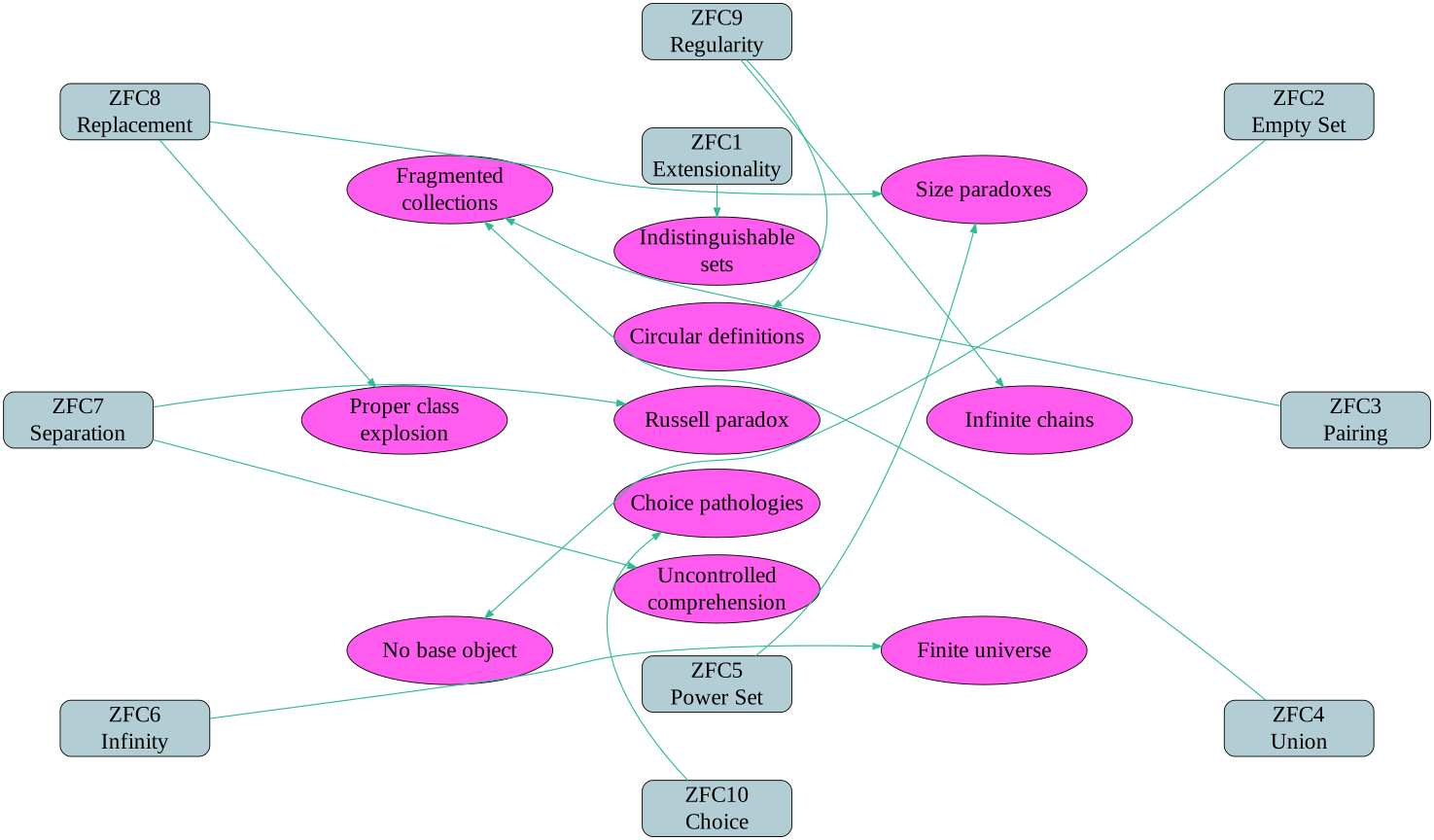
1. Extensionality Link to heading
In logic, extensionality or extensional equality refers to judging objects as equal if they have the same external properties. This contrasts with intensionality, which checks whether internal definitions are identical.
Two sets are equal if and only if they have the same elements. Any portfolio is determined by its elements: if two portfolios contain exactly the same policies, they are identical actuarially, regardless of presentation.
Paradox resolved: avoids ambiguities in set identity and prevents confusion between different definitions claiming the same collection.
\forall A \, \forall B \, [\forall x (x \in A \leftrightarrow x \in B) \rightarrow A = B]\tag{ZFC1}
2. Empty Set Link to heading
There exists a set with no elements. Risk modeling often starts from the state with no events and no exposure — the zero point of any mathematical construction. Actuarially, this corresponds to consistently handling situations with zero, one, or multiple claims, all integrated into a single analytical model.
Paradox resolved: fixes a well-defined starting point and prevents ambiguities related to the set of all nonexistent things that could otherwise lead to inconsistent interpretations of existence.
\exists A \, \forall x \, (x \notin A)\tag{ZFC2}
3. Pairing Link to heading
For any two sets $ A$ and $ B$, there exists a set containing exactly them. This is the basis for elementary aggregations: two risks can be studied together as a composite entity.
Paradox resolved: eliminates primitive pairing construction issues and avoids ambiguities when defining binary relations as informal “objects.”
\forall A \, \forall B \, \exists C \, (A \in C \land B \in C)\tag{ZFC3}
4. Union Link to heading
For any set $ A$, there exists the set $ ⋃A$ containing all elements of the members of $ A$. This is the structural operation for aggregating portfolios and scenarios.
Paradox resolved: provides a clear rule for flattening collections, preventing ambiguous constructions like the set of all elements of elements, which if informal could degenerate into contradictions.
\forall A \, \exists B \, \forall x \, [x \in B \leftrightarrow \exists C (C \in A \land x \in C)]\tag{ZFC4}
5. Power Set Link to heading
For any set $ A$, there exists the set of all its subsets. Actuarially, this is equivalent to enumerating all subsets of a portfolio, ensuring a coherent $ \sigma$-algebra and a complete description of all possible scenarios or strategies.
Paradox resolved: (ZFC11 + ZFC5 + ZFC7 + ZFC3 + ZFC4) clarifies cardinality hierarchy (via Cantor’s theorem2) and prevents the problematic notion of a set of all sets leading to Cantor’s paradox and universal set contradictions.
\forall A \, \exists P \, \forall B \, (B \in P \leftrightarrow B \subseteq A)\tag{ZFC5}
6. Infinity Link to heading
There exists an infinite set containing ∅ and closed under $ x \mapsto x \cup \{x\} $. Fundamental for stochastic processes, infinite series, open-horizon flows, and recurrences. Justifies Hilbert’s infinite hotel; otherwise, it would remain just an amusing story. As argued by Deutsch (2011), if you reject the infinite, you are stuck with the finite, and the finite is parochial.
Paradox resolved: introduces infinity in a controlled way, avoiding inconsistencies from the absence of an infinite structure; ensures the existence of $ \mathbb{N}$ without contradictions related to all finite sets.
\exists A \, [\emptyset \in A \land \forall x (x \in A \rightarrow x \cup \\{x\\} \in A)]\tag{ZFC6}
7. Separation (Separation Scheme) Link to heading
From any set $ A$ we can extract the subset of elements satisfying a property $ \varphi(x)$. Filtering portfolios, selecting claims with a specific profile, extracting eligible cases — all rely on this principle.
Paradox resolved: directly resolves Russell’s paradox3 by restricting comprehension: only subsets of an existing set can form a set.
\forall A \, \exists B \, \forall x \, [x \in B \leftrightarrow (x \in A \land \varphi(x))]\tag{ZFC7}
8. Replacement Link to heading
The image of a set under a definable function is also a set. Formalizes systematic application of pricing, updating, or transformation functions to all elements of a portfolio.
Paradox resolved: controls image constructions, preventing “too large” collections (which would otherwise become proper classes), reducing the risk of Burali-Forti-type paradoxes with ordinals.
\big[\forall x \in A \, \exists! y \, \varphi(x,y)\big] \rightarrow
\exists B \, \forall y \, [y \in B \leftrightarrow \exists x \in A \, \varphi(x,y)]\tag{ZFC8}
9. Regularity Link to heading
Every non-empty set contains an element disjoint from itself; there are no infinite membership chains.
From a mathematical point of view, the axiom of regularity eliminates membership cycles and enforces a well-founded structure of the set-theoretic universe. In this strict sense, it avoids forms of ontological self-dependence that appear in circular or non-founded constructions.
In a deliberately limited interpretation, this elimination of structural self-dependence can be seen as making the modeling of agents as well-founded entities more natural, without circular ontological support. Only within this restricted framework can one metaphorically speak of a formal space in which the idea of free will is not excluded a priori, but may be viewed as a potential point of emergence.
Regularity addresses ontological structure, while Gödel’s theorems4 address epistemic limits. There is no direct logical implication between them.
In other words, ZFC9 does not establish free will, nor does it block it; at most, it makes a particular modeling choice more natural. That’s it. The rest is philosophical noise.
Resolved paradox: it prevents the emergence of self-referential sets and non-well-founded constructions (e.g., Quine-style cycles5), removing a source of paradoxes and ambiguities related to circular membership.
\forall A \, [A \neq \emptyset \rightarrow \exists x (x \in A \land x \cap A = \emptyset)]\tag{ZFC9}
10. Axiom of Choice Link to heading
For any family of nonempty sets, there exists a function selecting one element from each. Justifies selection of representative scenarios, parameter choices, optimal strategies, and construction of measurable bases.
Paradox resolved / consequences: does not resolve classical paradoxes per se — rather ensures the existence of selectors where no constructive rules exist. Leads to counter-intuitive results (e.g., Banach–Tarski paradox) and is independent of ZF.
\forall A \, [\emptyset \notin A \rightarrow
\exists f: A \rightarrow \bigcup A \, \forall B \in A \, (f(B) \in B)]\tag{ZFC10}
Basic Desiderata Link to heading
To maintain credibility and objectivity, we formulate a set of basic desiderata, opposable equally to any rational robot (actuary). We adopt both the notion of a rational robot and these desiderata, essentially as identified by Jaynes (2003), slightly adapted.
These conditions uniquely determine the rules by which any objective robot must reason; in other words, they define mathematical operations for obtaining plausibility as credible as possible.
\textit{Degrees of plausibility are represented by real numbers.}\tag{D1}
We cannot conceive a coherent theory without a functional property equivalent to (D1). It is needed to represent higher plausibility by a larger number, so that $ (A|B) > (C|B)$ means that, given $ B$, $ A$ is more plausible than $ C$.
\textit{Qualitative correspondence with common sense.}\tag{D2}
This qualitative requirement only provides direction for the robot’s reasoning. It does not fix numeric rules, but constrains reasoning to align with rational intuition.
Finally, we assign the robot another desirable property—one humans tend toward without always reaching it: consistency of reasoning.
\begin{gathered}
\textit{If a conclusion can be reasoned out in more than one way, then} \\
\textit{every possible way must lead to the same result.}
\end{gathered}\tag{D3a}
The following desiderata must always be considered when information is split into classes. Information is relevant if and only if it distinguishes between competing candidate explanations of the same phenomenon, eliminating, restricting, or favoring some explanations over others.
Any aggregation or refinement of classes is admissible only to the extent that it preserves this explanatory structure6 and does not introduce artificial differences between explanations that are informationally equivalent. One cannot hide information through aggregation or invent signal through refinement.
\begin{gathered}
\textit{The robot always takes into account all of the evidence it has} \\
\textit{relevant to a question. It does not arbitrarily ignore some of} \\
\textit{the information, basing its conclusions only on what remains.} \\
\textit{In other words, the robot is completely nonideological.}
\end{gathered}\tag{D3b}
(D3b) eliminates convenient cherry-picking of information, and (D3c) imposes a form of epistemic invariance. Both are structural, not ethical: without them, any “model” becomes dependent on rhetoric, not data.
\begin{gathered}
\textit{The robot always represents equivalent states of knowledge by} \\
\textit{equivalent plausibility assignments.}
\end{gathered}\tag{D3c}
In other words, for the same knowledge state—or for two equivalent cases twin agents—we must assign identical plausibility values.
Critical note: Jaynes (2003) does not introduce these desiderata as arbitrary axioms, but for the need for minimal coherence conditions. Without them, one does not obtain an alternative theory of reasoning, but absence of credibility.
References Link to heading
@online{cornaciu2025ZFC+,
  author   = {Cornaciu, Valentin},
  title    = {Formal Foundations (ZFC) and Epistemic Desiderata},
  year     = {2025},
  date     = {2025-12-25},
  url      = {https://rcor.ro/en/posts/2025-12-09-axioms-of-set-theory/},
  abstract = {Structural analysis of the regularity axiom in ZFC, epistemic desiderata,
  and modeling implications in science and actuarial practice}
}
Deutsch, David. 2011. The Beginning of Infinity: Explanations That Transform the World. London: Penguin Books.
Jaynes, Edwin T. 2003. Probability Theory: The Logic of Science. Edited by G. Larry Bretthorst. Cambridge: Cambridge University Press. https://altexploit.wordpress.com/wp-content/uploads/2017/07/e-t-jaynes-probability-theory-the-logic-of-science.pdf.
-
If $ f : A ^A$ is the supposed bijective function, define the diagonal set:
D \;=\; \{\, x \in A : x \notin f(x) \,\}and apply Cantor’s diagonal argument. ↩︎
-
The theorem shows that it is impossible to create a bijective correspondence between the elements of a set $ A$ and the elements of its power set $ 2^A$. ↩︎
-
Russell’s paradox (naive version) starts with the set
R \;=\; \{\, x \mid x \notin x \,\},which immediately leads to the contradiction
R \in R \;\Longleftrightarrow\; R \notin R.In ZFC, the global definition of such a set is not allowed. Instead, the separation scheme only provides subsets of an already existing set: for any set $ A$ we can define
R_A \;=\; \{\, x \in A \mid x \notin x \,\},and $ R_A$ does not generate the global contradiction of $ R$ because it is constrained as a subset of $ A$.
Imagine a city with a barber who shaves all those who do not shave themselves. ↩︎ -
There exists a sentence $ G_T $ such that, under the standard interpretation of natural numbers, $ G_T $ is true but not provable in the formal system $ T $.
Specifically, $ G_T $ is constructed to express, in the arithmetic language of $ T $, the statement:
“The sentence encoded by this statement is not provable in the formal system $ T $.”
This is formulated internally in $ T $ via arithmetization of syntax (Gödel numbering), not through informal semantic self-reference.
At the metatheoretical level, assuming $ T $ is consistent:
- $ G_T $ is not provable in $ T $;
- the negation of $ G_T $ is not provable in $ T $;
- in the standard interpretation of natural numbers, $ G_T $ is true.
It is crucial to distinguish between:
- the content of $ G_T $, which only asserts its own unprovability, and
- its truth status, which is established exclusively at the metatheoretical level.
Confusing these two levels is precisely the error Gödel’s construction avoids. ↩︎
-
“Generates a false statement when preceded by its own citation” generates a false statement when preceded by its own citation. ↩︎
-
In the sense of Deutsch (2011), a good explanation is not defined by its degree of confirmation, but by its resistance to arbitrary variation–hard to vary. An explanation is good if it explains the phenomenon without ad-hoc adjustments and cannot be substantially altered without losing explanatory power or conflicting with other well-established explanations. Affirming that IBNR must be split into classes just because this is current practice represents a norm devoid of sense, which should be avoided in the absence of an explanatory justification. ↩︎